|
Puppy Culture Potluck SeriesYou bring the topics, we bring the discussion.
No time to read our Puppy Culture Discussion group every day? No problem! Now you can get highlights of the discussion group in podcast format.
I’m going to be grabbing questions from the discussion group that sparked interesting discussion and talk about them on air.
Who knows, some guests may drop in as well…
|
I unpack the emotion around this phenomenon and why, if you do the right protocols with young puppies that display resource guarding behavior, your chances are very good for an excellent outcome - meaning zero resource guarding and a puppy that you can confidently place in any home.
Listen wherever you get your podcasts, and subscribe so you never miss an episode!
    
   
To read the transcript for this episode, click the link below.
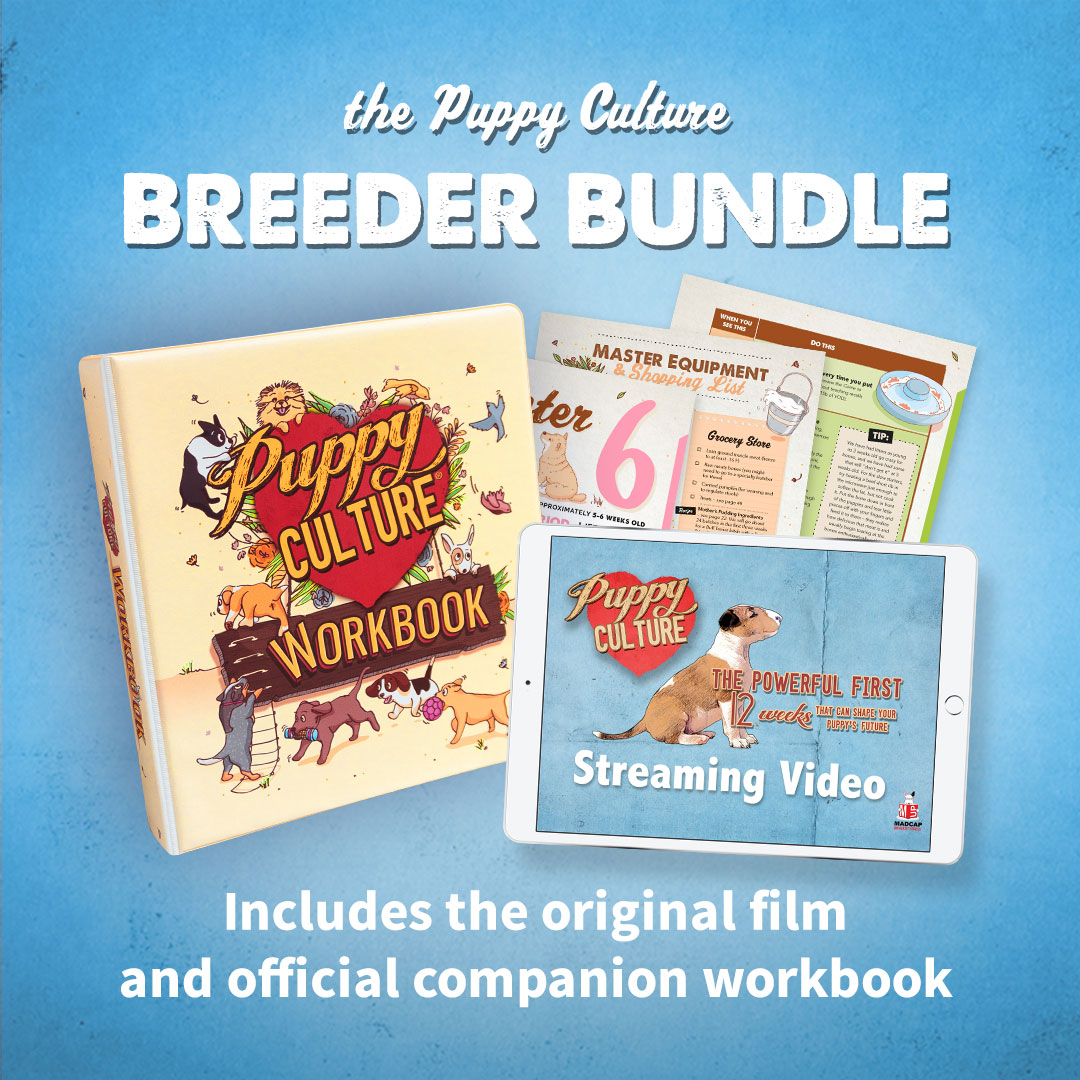
 Transcript - Episode 55I'm Jane Messineo Lindquist. And this is a Puppy Culture Potluck podcast. You bring the topics, we bring the conversation. This episode's question is from a breeder that is worried about her puppy being aggressive. And let me say before I read it, it's long. There's a lot of detail, but all of the details are important. So I'm going to read the whole thing. Here's the question. I have a quandary. You've addressed aggressive behavior before but ... I have an eight week old toy poodle puppy that showed signs of aggression earlier this week. I've never seen that in my puppies or in my adult's. I had given the puppies high value long chew turkey tendons treats in the pen. I put in plenty extra. This one puppy was hoarding the extras. Another puppy was trying to get one because she didn't have any. When the other puppy tried to get one the aggressor darted out at her but did not attack. I reached in to grab one of those extra sticks and she kind of came at my hand. I picked her up and she was aggressive, snarling, trying to bite, etc. I took her and two of the sticks and put her into a closed crate and gave her one stick, and then tried to take the other stick to give her another four, and she just lost it, was snarling, trying to bite me, that kind of thing. Very aggressive. Exclamation point. The next day, my husband tried to pull crusties off her behind and she was aggressive with him. Granted, he was hurting her, but he'd never seen that kind of snarling and snapping either. That wasn't resource guarding. She hasn't done it since. I have not given her the highest value treats again. She eats fine in the community Puppy Bowl. She can eat tossed kibble off the floor amongst the other puppies and the adult dogs. She's generally playful, bouncy, active, and puppy and people oriented otherwise, I will say she's a bit of a complainer. My son, 23 years old, says whenever he picks her up, she always has a little fuss, squeak, as if he might have hurt her. She went to the vet on Wednesday and everything checked out fine, so I don't think there's anything wrong. I think she's just a vocal one. I've decided to practice giving treats occasionally by hand, but not to take them away so that the hand is always giving and good, rather than taking and threatening. Later she can learn, drop it, give, leave it, etc. but what do you think about placing a dog like this with a family that has children? That seems to be most of my applicants. I know Jane, that you've said that these behaviors are not necessarily indicative of adult behavior, but what do you think of this instance specifically? Okay. Me again. Well, this one is a doozy and a great one because it gives us a chance to talk about so much. Let me open up by saying that what she's describing as aggression covers different behaviors springing from different wells. The good news is that I would not call this an aggressive puppy. We have very good explanations for all of these behaviors that this puppy's displaying. And none of them involve the puppy being inherently aggressive or having an aggressive temperament totally out of love. This breeder made this situation much worse by the way she handled it. I want to be clear that the reason I'm saying this is not to throw shade on the breeder, but to make her and others feel better about a puppy like this. And the prospects for a puppy like this. If she had done everything perfectly and the puppy was behaving this way, we might be having a different conversation. But the really good news is that she did almost exactly the wrong thing three times in a row. So we really can't make any judgments on this puppy until she goes back and does the right thing for a couple of weeks. So what I'm going to do is I'm going to pull out, excerpts from her original post and address them individually. And the reason I'm doing that is because I think we have to address the underlying emotional content from the breeder on this post and how it interferes with her ability to clearly see behaviors for what they are. And this is a really common theme with breeders, okay? Because when we see behaviors that in our primal mind look to us as aggressive, it's like all our reasoning centers just shut down and we just read lights are going off alarms like, oh my gosh, an aggressive puppy, an aggressive puppy. It's going to end badly. And we just can't keep that dispassionate behaviorist frame of mind. And I get it. But this is a really good illustration of how we have to do that, and how we do a disservice to the puppy if we get ahead of ourselves with labeling these puppies. So, she says, I had given them high value long chew treats in the pen. I put in plenty extra. Okay, so my first thought is that she's thinking that the fact that there are a lot of tendons, an abundance of resources, means that the puppies will never squabble over resources. I understand how she can have this misapprehension. So let me clarify. In the Puppy Culture workbook in the newborn to New home course, the breeder course, I do emphasize that you should always be putting twice as many bones in or resources in as there are puppies. How shall I say this? This is not a guarantee that a puppy is not going to defend its possession when approached by another puppy. All it does is lower the likelihood that one puppy who feels possession over its object is going to be approached by another puppy. Once a puppy feels possession over an object. The fact that there's an abundance of other objects that it could have, it's not going to diminish that puppy's feeling of ownership. Okay. But again, the only thing that having a lot of objects around does is it means that it's not going to force the puppies into conflict. Okay. If one puppy doesn't immediately find a bone in one area, they're going to find one another area. If they drop it and walk across the pen, there's going to be another one. In sum putting a lot of objects in the pen does not guarantee there will be no resource guarding between puppies, but putting few objects in the pen greatly raises the possibility that there will be real conflict and defense as those puppies compete for those limited resources. Which, by the way, ties in to her comment about this puppy being able to eat from a communal dish and eats scattered treats with absolutely no reaction because the puppy doesn't feel ownership over those things. Okay. The whole thing about resources, like bones is it's a discrete object that can be taken and possessed by a puppy that the puppy feels possession. Puppies generally don't feel possession over a communal dish, which is why, even though you might see them squabble over bones, you're generally not going to see them squabble around a communal feeding dish. They just don't feel that possession. Then she said this one puppy was hoarding the extras. Again, you can feel the emotional content being imputed to this puppy here. Okay. She started out with I've never seen anything like none of my puppies have ever done this. And then the puppies hoarding the extras. All of these things are set ups for lay balling this puppy as unreasonable and aggressive. And I would ask anyone with a puppy like this to please let go of all of that and just identify this behavior for what it is, which is that this particular puppy will take possession of any stray chew treats. Then she said another puppy was trying to get one because she didn't have any. Again, the puppy that has the quote unquote hoard of tendons does not have the abstract concept of fairness. To understand that she has many of this resource, and the other puppy has none. Also, the fact that the other puppy had none does not make it right for that puppy to try and approach and remove a tendon from the quote unquote, hoarding puppies possession. We can feel that this breeder is siding with the puppy that has no tendon, and feeling ill disposed toward the puppy that's trying to just keep possession of her stuff. I understand why she feels that way. But as humans, we do have a sense of fairness, and it's not fair to label a puppy unfavorably when they're displaying natural dog behavior. I'm just going to pause here and say this question came from the Newborn to New Home breeder course discussion group to the students of that course. So this particular breeder has seen Puppy Culture, and she's taken the Newborn to a New Home course. So she knows what's natural and normal for a puppy. But for those of you who might not have seen Puppy Culture or taken the course, let me explain. Probably the most important in my opinion protocol in Puppy Culture is Jean Donaldson's anti resource guarding protocols that she so generously allowed us to film and present in Puppy Culture. And I also have to say that it's probably the least done protocol because so many people like this breeder say, my breed would never do that. My breed is not aggressive. Okay. When we interviewed Jean something that I did not include in Puppy Culture, but I really wish I had was her saying that the most vigorous resource guarder she had ever had was a Cavalier King Charles Spaniel. Now I know it's a small dog, so maybe not as dramatic as a larger breed that resource guards. But the point is, it's something that happens in all breeds, and every breeder needs to do these protocols. It's a behavior that is at once very alarming and destructive for the puppy owner and the puppy owner's relationship to the dog. And happily, the vast majority of the time very easily modified if you do these protocols as a breeder before the puppies go home. But back to your expectations. As a breeder, you just have to take it as true that this is natural and normal puppy behavior. We go over this in the film, we go over this in the courses. But this is natural behavior, okay? A dog in the wild that would not defend its possessions would starve the puppy that has the tendons, that is defending her possessions as a pup. Another puppy approaches her. She's right. That's natural dog behavior. She would be abnormal if she didn't defend her things. And you know, the entire resource guarding protocols that Jean presents are not just about anti resource guarding, okay? It's about how to create good conditioned emotional responses. It's a discipline. You have to do it the right way. You have to get the timing right. You have to get the hierarchy of value of reinforcers right. And as you're going to see as we go through here, this breeder unfortunately got them all wrong because I'm going to imagine she skipped that part because she figured my dogs would never resource guard. So then she says when the other puppy tried to get one, the aggressor darted at her but did not attack. And I say, fair enough. It's very natural behavior and kudos to this puppy for pulling her punches. Again, as Jean Donaldson and I both mentioned, in Puppy Culture, this is normal dog behavior. A dog that allowed other dogs to take things from them in the wild would never survive. So, so far everything this breeder has mentioned is 100% good normal dog behavior. Now we come to this part. She says, I reached in to grab one of those extra sticks and she kind of came at my hand. I picked her up and she was aggressive, snarling, trying to bite, etc.. Okay, two separate things here. First, when that breeder reached in and tried to take one of those tendons from that puppy, and that puppy showed a willingness to defend her possessions from a human. That's when you say thank you for showing me that. And you go right back to the anti resource guarding protocols in Puppy Culture and start from the ground up with that puppy. Again, for those of you that might not have seen the film, we had a six week old puppy that just about tried to bite my hand off when I took something away from him. Very similar situation. Other puppies were crowding in on him. I reached in to take his bone to do a resource guarding exchange. He came at me. Anybody looking at that would be like, oh, that puppy's terrible. Well guess what? We followed that puppy through to adulthood, to his home. You could lay down in a crate with your face right next to that puppy, and take a marrow bone away from him. We filmed it. We put it in Puppy Culture so people could see the ultimate proof that these protocols done on young puppies do really work. That dog passed away at 13 years old not long ago. Could not have been a better pet. His entire life never showed a smidgen of resource guarding. But when he showed his willingness to take things from me, what did I do? I said, thank you very much. And I started doing resource guarding exchanges with him. But in the moment, what did this breeder do? She panicked and picked up the puppy. I get it. She's upset. You don't want your puppy to be this way. You're just saying no, no, no. My puppy. No, don't do it. You just. You're going to show her. No, don't do that. But guess what? It's not surprising that she objected and tried to bite at your hands. Because that breeder just confirmed all of the puppies worst fears that you would part her from her precious pearls of possessions. So that's the first thing. But on top of that, this breeder interrupted a puppy in a glorious chew session and didn't pay the puppy for it, just yanked her out of it. So what conditioned emotional response is being created here? A negative one, not a good one. The breeder is going to take stuff away from me, and she's not going to give me anything. She's going to interrupt me and not give me anything. So that's two times in one transaction that this breeder has created the wrong conditioned emotional response, not the conditioned emotional response. We want to be creating. So I talked about resource guarding protocols. But separate from those resource guarding protocols, we should all be doing interruption protocols where we quickly pick up a puppy that's very involved in a project. Something absorbing. It can be a chew project, it can be playing, and you pick that puppy up and just shove the highest value treat you can get your hands on into the puppy's mouth, and then just put the puppy down immediately. If that puppy is snarling when you pick it up, I don't care. Just shove the treat in and put the puppy down. This is about creating a condition of emotional response. It doesn't matter what the puppy's doing when you pick it up. We do cover this lightly in the original puppy culture film, but I go into it in great depth in the With Open Arms Course for puppy owners. Because I talk about ratios of treat pickups to blanks, what you how many you need to do depending on the way that the puppy's presenting. But as breeders, we should be instilling this on an ongoing basis. Interrupt pick up feed put down. Because remember your average puppy owner is going to be doing what? Trying to control the puppy by picking it up. So you have been putting a lot of money into the relationship bank that picking up predicts great things - I get fed. You want to hand that to your puppy owner, okay, because the puppy owner is not probably going to be as good as you as a breeder at remembering to do that. So the more again, money in the bank, you can have in the sense of creating a good condition or emotional response or CPR as we call it, to being interrupted and picked up. The better it's going to go for the puppy family. We want to steal encourage the puppy family to be doing the creating a good CPR to being picked up, but realistically, you as a breeder are going to be more tightly disciplined about doing this than the puppy family is. So I'm going to say that's something that you as a breeder should be mastering. And practicing on a regular basis, and it does not have to be sessions. In fact, I highly recommend that it's not sessions, that you walk through the room and pick up a random puppy. Always have treats in your pockets. Just pick up a random puppy. Give it a treat. Put it down. That's it. Keep going. You're carrying laundry to the laundry room on the way back. Pick up a puppy, feed it. Put it down. Okay, let's move on to her next comment. I took her and two of the sticks and put her in a closed crate and gave her one stick, and then tried to take one stick and give her another, and she just lost. It was snarling, trying to bite me, that kind of thing. Very aggressive exclamation point. Me again. No. Not aggressive. Just incredibly frustrated. This is the most basic part of doing effective resource guarding exchanges. Okay, is you start with a low value object. So the puppy has a low value object and you trade it for a high value object. Trading two equal value objects is only going to increase frustration and resource guarding. So this was a very predictable result. In fact, you could almost say if you wanted to train aggression and resource guarding, this would be how you train it. So for me with this puppy, zero of this concerns me, except for the fact that now this puppy has three super unproductive interactions on board with you on this topic. Any breeder in this position should just go back to the anti resource guarding section of Puppy Culture and follow it carefully and in fact, that is what this breeder decided to do because she said she was going to start bringing her hand in with treats and not taking away, which is the first step that Jean Donaldson demonstrates. So that's good that this breeder, you know, got there on her own. As far as what the first step is, listen, as Jean Donaldson says in the film, there are no 100% given in behavior modification protocols, but the closest you can get is a good protocol done on a young puppy. And resource guarding is highly modifiable. But you do have to have the right timing and not test or challenge the puppy and be very correct in your protocols, timing, body position, and relative value of resources. And I cannot overemphasize that. You have to wait until you have a good CFR on each level before moving to the next level, and these protocols have to be done away from the other puppies. Each puppy needs to be alone in the room with you. When you're doing these protocols. Okay, back to the original post. The next day, my husband tried to pull crusties off her behind and she was aggressive with him. Granted, he was hurting her, but he'd never seen that kind of snarling and snapping either. That wasn't resource guarding. Okay, me again. So this is the next day after three negative interactions with the breeder and the puppy was being hurt. This is just an illustration of what happens when you make big withdrawals from the relationship and trust bank. It's totally predictable that this puppy would be quick on the draw when someone was hurting her the next day, she's been primed not to trust people, and she's going to just go right to the bottom line when she's being hurt. I can't blame her. Then the breeder asks, but what do you think of placing a dog like this with a family that has children? That seems to be. Most of my applicants. Well, my answer to her is you really have no idea about this puppy until you've done clean protocols with her every day for a couple of weeks. My guess is that she's going to be a fine companion with zero resource guarding. Rocco was. But I want to pause here because this is important. While this is natural behavior, and while I have very optimistic feelings about this puppy or a puppy that behaves this way. You as a breeder have to hold that puppy back until you have successfully counter conditioned this behavior. You cannot place a puppy that is showing any hint of this kind of behavior with a puppy family, and give them instructions and hope that they are going to deal with the problem. Because trust me, they are not. This is where we as breeders need to apply our expertise to these puppies. What does that mean? Well, it means a lot of inconvenience at times. It means that you may be holding a puppy back for many more weeks than you wanted to. It means that you should tell every puppy owner that's flying in to get a puppy to buy a refundable ticket, because things can change, schedules can change. But again, you as a breeder cannot place a puppy that is displaying this kind of behavior with a puppy family, you have to hold that puppy back and work with that puppy yourself until the puppy shows zero resource guarding. And I know in the moment, as a breeder, it is very hard to want to do that. You just want to get on with your life. You need to place those puppies. For some breeders it's a financial issue. But listen to me. If you place an 8-10 week old puppy that has shadows of resource guarding that you have not fully counter conditioned with the puppy family and the puppy family then fails and the resource guarding escalates. Now you're going to get back a five, six, seven month old one year old dog. That's resource guarding, that's dangerous, that you can no longer go through the quick resource guarding protocols like we have in Puppy Culture. The now becomes an extensive program of possibly months or years of counter conditioning and desensitization and professional help and big bucks. And you do not, you do not. You do not want to be in that position. So as painful as it is in the moment, do your future self a favor and complete the work with these puppies before you place them. So my suggestion to this particular breeder was that we adjourn on deciding where this puppy goes for a couple of weeks and look at her again at that time. And then a couple days later, the breeder wrote in, I appreciate your input. I definitely recognized after the fact that my response frustrated her and reinforced her concern over being parted from her precious pearls of possessions. I love that, and I agree, I gave it a few days and observed that although she can be vocal, she's not aggressive. I was thinking I'd work on her for another week or two and then reconsider, but I'm really glad to hear that you're not concerned. And it was me and my husband creating this situation. Yeah, and my response was, I can't promise nothing's 100%, but there's so much in the story to make me very hopeful and optimistic. So if there is one thing, one takeaway I want everyone to have from this episode, it's that even if you think that you have a breed or a litter of puppies and you've never seen resource guarding for all that is holy, please do the anti resource guarding protocols because even if your puppy doesn't show what you would call aggression when defending objects, the emotional state is there. Okay, the puppy is having something taken from it and it may not express as a willingness to defend its object, but the underlying emotional state is there. You're creating a negative emotional state in the puppy which can express itself in other ways that are not desirable. And you as a breeder, really your stock in trade is creating good conditions and emotional responses. That's what socialization is. And if you don't understand how to trade hierarchy of value, how to be disciplined in presenting different stimuli, you're going to be less successful in creating good conditioned emotional responses, probably when the puppy doesn't have any, inherent emotional content in things, you're going to get away with a lot of habituation, but where there is inherent emotional content that you want to counter, conditioned that you want to change, you need to have control. You need to have command over how to create conditioned emotional responses. And that's what's in Puppy Culture. In the anterior force guarding protocols. So do it for yourself as a breeder. Do it for your own education. Your puppies will thank you for it. If you like this podcast, you'll love Puppy Culture. Available at puppyculture.com. We have breeder bundles, we have puppy owner bundles and we have a puppy owner course with Open Arms and a Level Head: How to welcome a Puppy into your Life, available at puppyculture.com. Breeders. Have you stocked up on booklets? We have Be Your Puppies advocate booklets, we have puppy exercise booklets. We have spay neuter booklets available at puppyculture.com. Well, that's it for this time. Thanks for listening. Bye bye. Thank you. Referenced Courses and Titles
0 Comments
Your comment will be posted after it is approved.
Leave a Reply. |

AuthorJane Messineo Lindquist (Killion) is the director of "Puppy Culture the Powerful First Twelve Weeks That Can Shape Your Puppies' Future" as well as the author of "When Pigs Fly: Training Success With Impossible Dogs" and founder of Madcap University. Archives
October 2026
Categories |